Leaves Are Not Garbage
What We Lose When We Throw Away Autumn Leaves
There is something wonderfully beautiful about autumn.
The garden begins to loosen its grip. Flowers fade, seeds ripen, grasses turn golden, and the trees slowly release the leaves they have carried all summer. What was once green becomes a tapestry of gold, copper, russet, and brown—and eventually, the ground is covered in them.
And then, almost instinctively, we begin to clean them up.
Rake, blow, pile them up. Leaves are often put on the curb, often thinking of them as something that needs to be cleared away before winter arrives.
But what if we looked at those leaves a little differently? What if, instead of seeing them as debris, we saw them as habitat?
Last September, I wrote about the importance of Leaving Nature to Flourish—resisting our instinct to tidy every corner of the garden and recognizing that the land is not ours alone. It is a shared home, filled with countless lives that depend upon the places we so often consider untidy.
This autumn, I want to take that idea and focus on one thing: Let's talk about the leaves.
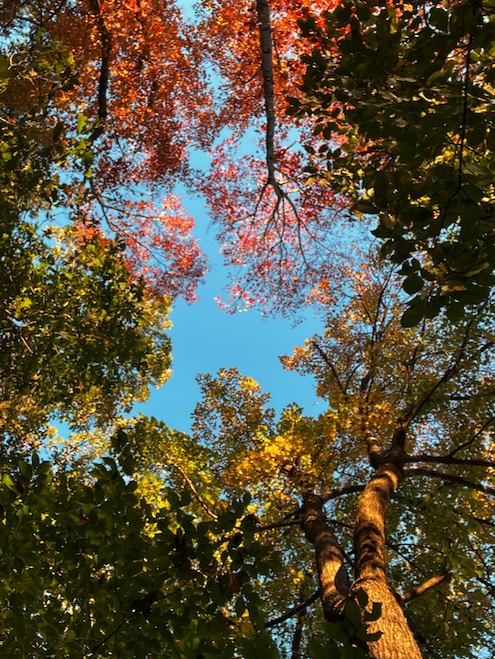
Looking up at the beautiful autumn foliage while walking along one of our forest trails
A Leaf Is More Than a Leaf
It is easy to think of a fallen leaf as the end of something.
The tree is finished with it for the year. The chlorophyll has been reabsorbed by the tree in preparation for dormancy. The leaves change color, fall to the ground, and now it seems destined for the compost pile—or worse, a plastic bag headed for the landfill.
But from the perspective of the forest floor, a fallen leaf is not an ending. It is the beginning of another part of the cycle.
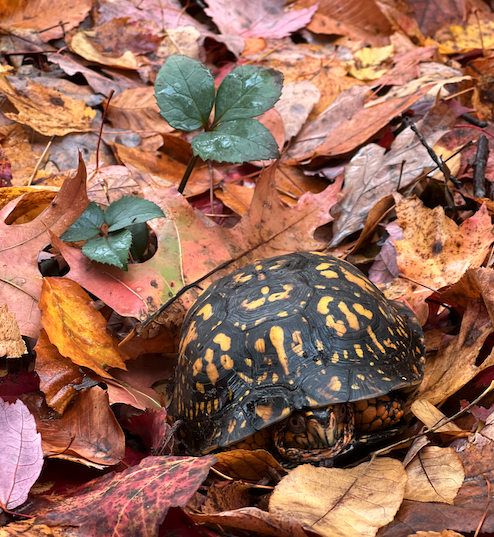
One of our resident Eastern Box Turtles getting ready to burrow for the winter
Leaves provide food and shelter for countless organisms. They create a layer of insulation over the soil, help retain moisture, and eventually break down into organic matter that returns nutrients to the earth.
And perhaps most surprisingly, they can be home to an extraordinary number of insects.
A Spring 2026 article in American Entomologist called “Bagged and Tossed” caught my attention because it put some research behind the “Leave the leaves” movement: when we remove fallen leaves, we may be removing much more life than we realize.
The article follows a study conducted by an undergraduate entomology class at Canisius University in Buffalo, New York. Students collected bags of autumn leaves from suburban yards in Western New York and carefully sifted through them to discover what was living inside. What they found was remarkable.
The researchers documented more than 25 insect species from nine different insect orders, along with spiders, centipedes, sowbugs, and ticks. They found insects in multiple stages of development and representing a variety of ecological roles.
In other words, those bags of leaves weren't simply bags of dead plant material. They were basically miniature ecosystems!
The Winter Garden Is Still Alive
One of the most important things to understand about autumn leaves is that they provide habitat during a season when we might assume the garden has gone quiet.
Many insects spend part of their lives in leaf litter. Eggs, larvae, pupae, and adults may use leaves for food, shelter, or protection from the elements. When we remove that layer, we aren't simply making the garden look tidier, we are changing the habitat.
The research behind Bagged and Tossed found insects that utilize leaf litter in a variety of ways, supporting the idea that autumn cleanup can remove insects from the landscape along with the leaves themselves. Their study is particularly valuable because it directly examined what was actually living in the leaf litter rather than simply assuming that leaves provide insect habitat.
And this matters because insects are not just tiny creatures that happen to live in our gardens. They are part of the infrastructure of an ecosystem.
They pollinate plants. They provide food for birds and other wildlife. They decompose organic matter. They cycle nutrients. They prey upon other insects and, in turn, become prey themselves. It’s all part of the circle of life.
A garden without insects would not simply be a garden with fewer bugs, it would be a fundamentally different ecosystem.
What Happens When We Bag Them Up?
Imagine a single autumn leaf falling from a tree.
It lands on the ground and joins thousands of others. Over the coming months, moisture settles in. Fungi and microorganisms begin breaking the leaf down. Tiny creatures move through the leaf litter. An insect shelters beneath it. Another feeds on the decaying plant material. A spider searches for prey. The leaf is slowly becoming part of the soil.
Now imagine that same leaf being gathered into a plastic bag. The entire process is interrupted.
The habitat disappears from the garden. The organic material that would have returned to the soil is removed. And the insects using that habitat are removed with it.
Multiply that by the bags collected from yards across a neighborhood, a city, or a country, and the scale becomes much more significant.
Research published in 2025 found that removing autumn leaves from residential yards reduced the abundance of spring-emerging arthropods by 17%. The effect was even more pronounced for Lepidoptera—the group that includes butterflies and moths—with a 40% reduction in species richness and a 45% reduction in abundance.
A few bags of leaves may not seem consequential, but ecosystems are built from countless small interactions.
So, Should We Never Remove Leaves?
Not necessarily. As with most things in gardening, the answer is not quite as simple as always or never.
A thick blanket of whole leaves can smother turf, block sunlight from certain plants, or create problems in places where drainage is poor. Leaves that have come from plants with serious diseases may also need to be handled differently. And there are certainly areas—walkways, driveways, roofs, and other functional spaces—where removing leaves makes sense.
The goal isn't to abandon our gardens entirely, it is to become more thoughtful about where the leaves go.
Instead of automatically sending them away, ask:
Can these leaves stay here? Often, the answer is yes.
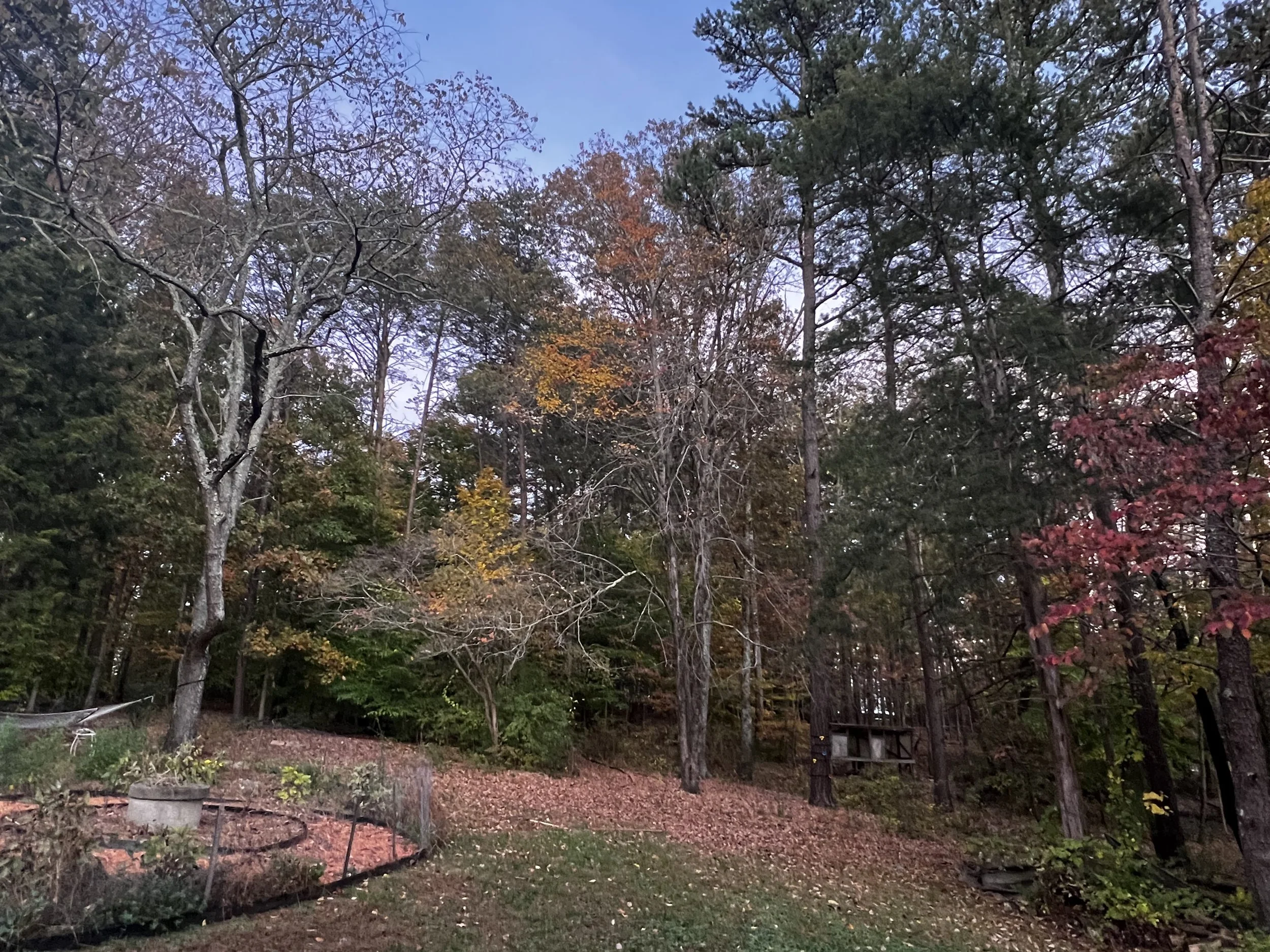
The front garden at Giardino Foresta in mid-autumn
Give Your Leaves a New Purpose
There are many ways to keep autumn leaves working for you—and for the ecosystem.
Leave them where they fall.
This is the simplest option.
Allow leaves to accumulate beneath trees, around shrubs, and rake them into garden beds. They will provide winter habitat while gradually breaking down and returning organic matter to the soil.
You don't need to make your entire property look like a forest floor. Even leaving portions of your yard undisturbed can make a difference.
Shred them in place.
If you have a thick layer of leaves on your lawn, consider mowing over them rather than removing them entirely. Chopped leaves can break down more quickly and return organic matter to the soil. You can also use shredded leaves as mulch around trees, shrubs, and perennial plants.
Make leaf mold.
One of my favorite uses for fallen leaves is something called leaf mold.
Simply put, leaf mold is decomposed leaves. Given time, moisture, and the right conditions, leaves transform into a dark, crumbly material that can be added to garden beds and soil. It is a beautiful example of nature's ability to turn what we call "waste" into a resource.
Add them to your compost.
Leaves are also an excellent source of carbon for the compost pile. Mix them with nitrogen-rich materials such as fresh plant material and kitchen scraps, and let decomposition do its work.
Create a little wild corner.
If you don't want leaves covering your entire yard, designate one area where they can remain undisturbed through the winter: Under a tree. Along a fence line. Behind the garden shed. It doesn't need to be perfect, iIn fact, that's the point! Mimic what nature has been doing forever and you’ll be off to a great start.
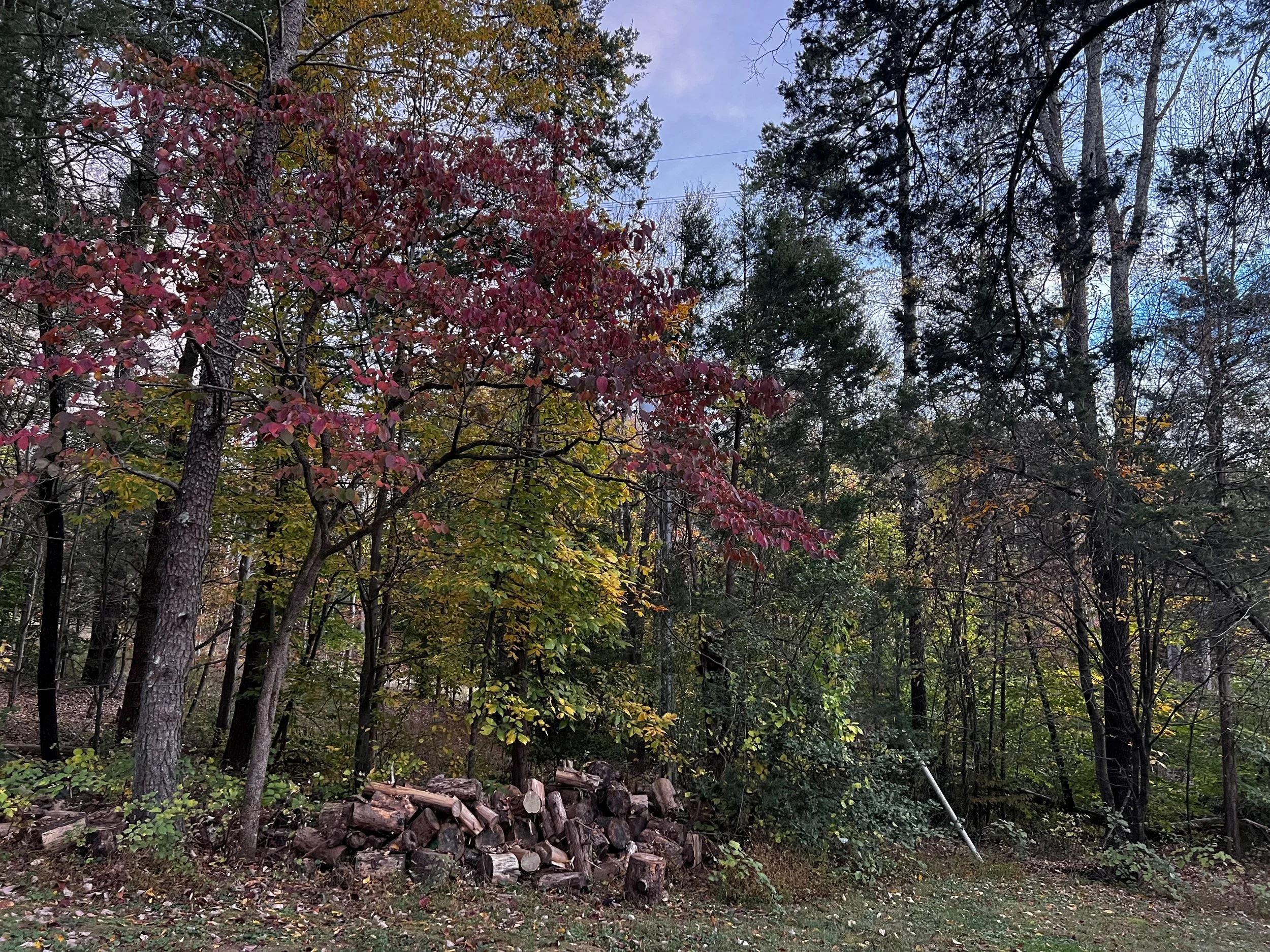
One of many wood piles around our property that we leave for the wildlife
A Different Definition of "Clean"
Perhaps one of the biggest shifts we can make as gardeners is to reconsider what a healthy garden is supposed to look like. We have inherited an idea of beauty that often equates tidiness with health.
Leaves are swept away. Stems are cut down. Seed heads are removed. Bare soil is exposed.
Everything is neat.
Everything is orderly.
Everything looks ready for winter.
But nature doesn't garden that way!
A forest doesn't rake its leaves.
No one goes through a meadow with a leaf blower.
There is no crew of gardeners arriving in November to clear away every fallen stem and seed head before winter sets in.
Instead, the organic material remains. Plants die back into the soil. Leaves accumulate. Seeds fall. Insects shelter. Fungi and microorganisms get to work. The garden is not being neglected, it is being allowed to continue living. That’s a beautiful thing.
Let the Leaves Be Part of the Cycle
This is really what Growing With the Flow is about. Not abandoning our gardens, but learning to work with the rhythms that are already happening around us.
Autumn is a season of release. Trees let go of what they no longer need, returning those leaves to the earth where they can become something new. We can participate in that cycle rather than interrupting it.
So this fall, before you reach for the rake or leaf blower, pause for a moment.
Look down.
Notice the leaves.
And remember that beneath that beautiful layer of gold and brown, there may be eggs, larvae, pupae, beetles, moths, spiders, and countless other small lives preparing for the season ahead.
What looks like a mess to us may be shelter to someone else. What society wants us to think is waste is nourishment. And what looks like the end of the growing season is another stage in the cycle.
The leaves don't need to go anywhere.
They can stay.
They can shelter.
They can decompose.
They can feed the soil.
They can become part of next year's growth.
Sometimes, the most meaningful thing we can do for nature is simply to resist the urge to tidy it away.
Let the leaves fall.
Let them remain.
And, in doing so, leave a little more room for nature to flourish.